
During his four-day-long stay in India, Biden will hold meetings with top Indian leadership, including President Pranab Mukherjee and Prime Minister Manmohan Singh.

Two Americans are among the five people from the United States who have been selected for India's prestigious Padma awards this year for their contributions in different fields.

India will welcome two trade missions in 2015 focused on meeting its infrastructure needs with US technology and services.

Corporates, realtors, and even IPL fixing -- the tentacles of the hacking network, whose alleged member was nabbed by a agencies of India, US, Romania and China on Friday, run broader than anticipated, reports Vicky Nanjappa.

'The interests of the United States and India are sharply aligned on the issue of Pakistan-based terrorism.'

'In the time I have been an Indiawallah, I have seen three US Presidential visits to India, nuclear sanctions, nuclear cooperation, a border conflict with Pakistan, the growth of IT services, a government losing a confidence vote, and so much more,' Rick Rossow, the new Wadhwani Chair in US-India Policy Studies tells Rediff.com's Aziz Haniffa.

A Priority Foreign Country is a status reserved for those nations that are the most egregious violators of intellectual property rights and have the most negative impact on US competitiveness abroad.

In a sudden development, S Jaishankar, India's Ambassador to the United States, was on Wednesday night appointed Foreign Secretary, replacing Sujatha Singh whose tenure has been abruptly 'curtailed" by nearly 8 months.

India said on Tuesday it was investigating US policies supporting solar panel makers, the latest move in an escalating row over renewable energy that has worsened already strained ties between the two countries.

This is the joint statement issued by the ministry of external affairs on the visit of US President Barack Obama to India.
.jpg)
Kerry said this in a newspaper article co-authored by US Commerce Secretary Penny Pritzker.

By hosting the 10 ASEAN leaders on Republic Day, India amply demonstrated that ASEAN is a central pillar of its Act East policy. But is India 'central' for ASEAN, asks Dr Rahul Mishra.

Asserting that its demand after Devyani Khobragade's arrest is not unreasonable, India has said the case is not about mistreatment of a domestic employee but rather of US laws being gamed for immigration purposes.

Dispute over IPR was a bone of contention in bilateral ties till a couple of months ago.

Brookings Institution tries 'Re-imagining India.' Aziz Haniffa listens in

The $10.5 billion arms and equipment deal helped to arrest the recent drift in the 'special and privileged' strategic partnership, observes Brigadier Gurmeet Kanwal (retd).

The prime minister and president stated their intention to expand defence co-operation to bolster national, regional and global security.

India is set to sign an agreement with the US to resolve transfer pricing disputes, which will then serve as a template for settling such rows with multinational companies based in the UK, France and other European countries.

Recognising the threat posed by outfits like the Al Qaeda, Lashkar-e-Tayiba and the Dawood Ibrahim network, India and the United States have agreed to deepen cooperation in fighting terrorism and asked Pakistan to bring to justice the 2008 Mumbai attack perpetrators.

Omkeshwar Singh, Head, Rank MF, a mutual fund investment platform, will answer your queries.

New book claims Amar Singh gave between 20 and 100 per cent of his entire net worth to the Clinton Foundation.
The West has always preferred a timid, half intelligent and a dependent India rather than a decisively independent and self-reliant one. A pliable Indian leadership suits the West best, says Tarun Vijay.

Ignoring the United States viewpoint, India has refused to consider the Devyani Khobragade episode as "closed", saying there are "residual" issues which need to be addressed.

Under the current administration, political attitudes toward IP seem to have improved.

Amazon committed a fresh investment of $3 billion, in addition to the $2 billion it announced in 2014.

Defence Minister Manohar Parrikar expects to see progress in India-US defence relations at the speed of a year per month.

'I could see it not having any impact whatsoever,' says Stephen P Cohen on Obama's India visit.

Sujatha Singh is the third senior official to have been dismissed by NDA.

US President Barack Obama on Sunday affirmed his commitment to enhancing India's 'voice and vote' in global financial institutions like IMF.

'Foreign policy-making cannot be shifted out of Delhi and the regional satraps, who do not have a national perspective, should not be allowed to dominate foreign policy. But regional inputs should be integral to foreign policy-making at every step of the way,' says Ambassador T P Sreenivasan.
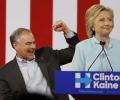
Rediff.com reproduces this 2014 interview with Tim Kaine where in he discusses the new opportunities to foster Indo-US trade and the improvement in ties.
.jpg)
In the first official visit by a United States vice-president to India in three decades, Joe Biden arrived in India on Monday on a four-day tour aimed at boosting ties in key areas of trade, energy, defence and security. The US vice-president will hold meetings with top Indian leadership, including President Pranab Mukherjee and Prime Minister Manmohan Singh, on Tuesday before flying out to Mumbai in the night.

United States Secretary of State John Kerry will travel to India on June 23 to co-chair the 4th India-US strategic dialogue, his spokesperson said on Wednesday.

Reflecting the strong bipartisan support to the India-US relationship, the lawmakers welcomed the decision of the House Speaker Paul Ryan to invite Modi to address the joint meeting.

Prime Minister Narendra Modi's address to a joint meeting of the United States Congress will be an opportunity to energise efforts to improve bilateral ties, top American lawmakers from across the political divide have said.

'If there's one administration that would be likely to put the squeeze on Pakistan, it's the Trump administration.' 'This is an administration that views terrorists as a black and white issue (kill them all, no questions asked), and will have little patience for Pakistan's selective policy toward terrorism.'

On the final day of Prime Minister Narendra Modi's visit to the US, that country on Tuesday extended its Defence Cooperation Agreement with India by another 10 years. The pact, which was to expire in June next year, will now be in force till 2025.

How will the return of a majority government at the Centre, the new India-US friendship and the Mangalyaan triumph change India?

Even as the United States snuggles closer to India with the thinly veiled objective of containing China, the Indian strategy is to avoid alienating either nation.
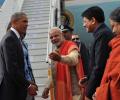
'Modi and Obama are transformational leaders. There can't be a better occasion than to see them together, making their own 'firsts' in a festival of the Republic of India,' says Tarun Vijay, MP.
